Global Hive
A global control plane connects identity, policy, regional discovery and a unified resource directory.
 NodeLift/
[ 01 / 11 ] DEMOCRATISING COMPUTING
NodeLift is building a cloud-orchestrated resource network to democratise access to memory, compute and services. Peer devices share useful capacity so existing and older hardware can do more.
TARGET ARCHITECTUREHive complete-model dispatch is live in a bounded pilot; mobile qualification and model partitioning remain open.15.11.2026
CLOUD HIVE / REGIONAL HUBS / PEER WORKERS
Cloud orchestration connects peer workers across regions. Resource placement serves capacity, useful performance and longer device life.
A global control plane connects identity, policy, regional discovery and a unified resource directory.
Regional orchestration manages workload queues, placement, leases and recovery under residency and operating policies.
Computers, workstations, phones, tablets and eligible consoles contribute through the same capability and work contracts.
Required model partitions place tensors and state across compatible workers, extending resident capacity beyond a single device.
Independent jobs, verified drafts and service adapters use the route that fits the workload, resource budget and measured transfer cost.
A shared ledger distinguishes physical resources, available capacity and delivered work. Fenced leases and workload-specific recovery protect result ownership.
03 / MISSION AND VALUE
ACCESS / CAPACITY / DEVICE LIFEA device’s useful life should not end at the limits of its own memory or processor. Shared infrastructure can create new ways to keep it useful.
Our mission is to reduce premature hardware replacement by connecting useful resources across an authorised network. AI is the first workload; the architecture also supports independent compute and service adapters.
Let a workload use memory and compute across qualified devices, including one model that exceeds a single machine’s resident capacity.
SHARED MODEL CAPACITYSelect the right execution route for a task. Measure the full result, including transfer, computation, verification and recovery.
END-TO-END COSTBuild personal and organisational resource networks that give more people access to workloads their device could not handle alone.
RESOURCE ACCESS04 / EXECUTION ARCHITECTURE
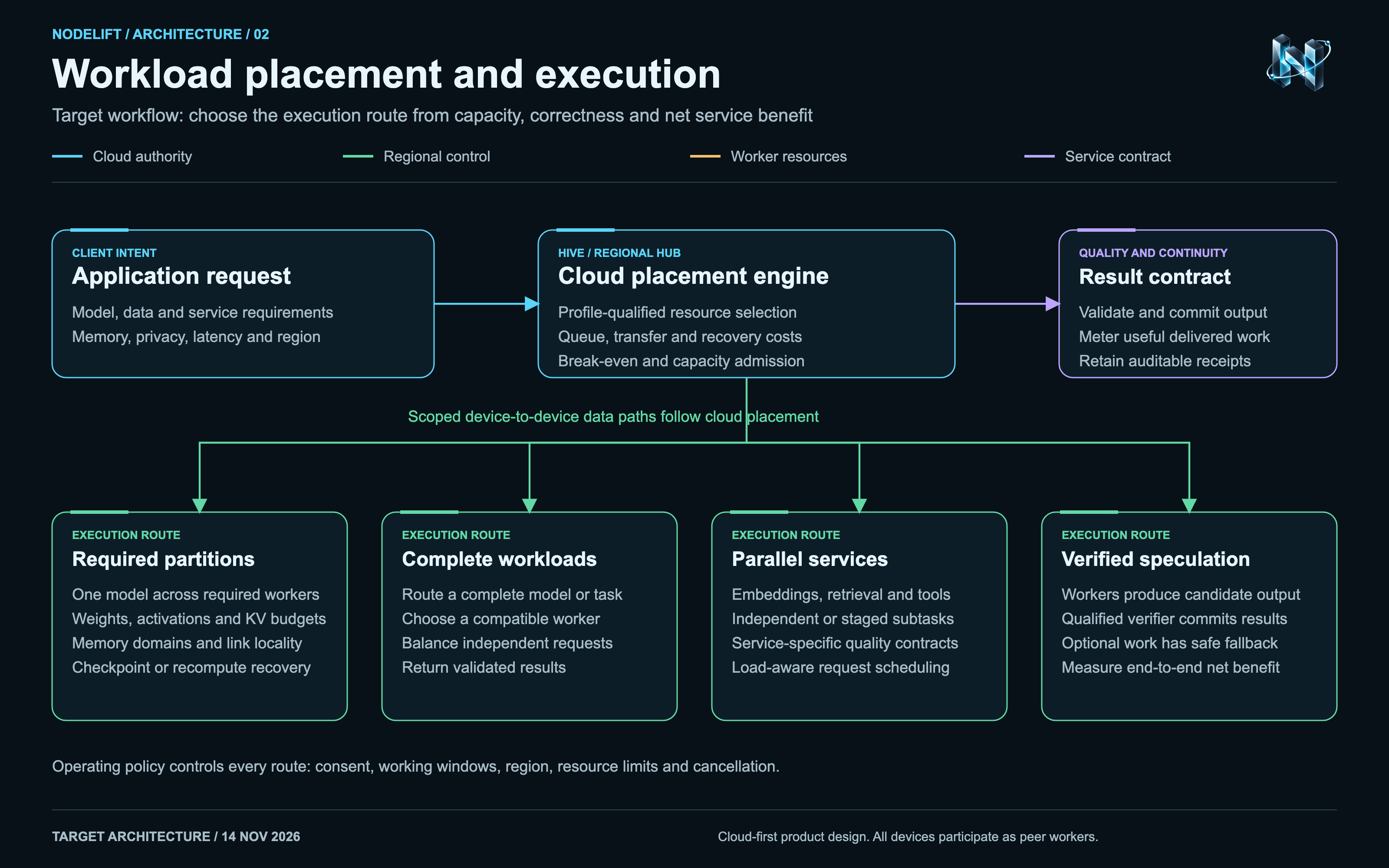
MEMORY / COMPUTE / SERVICESThe engine is designed around required model partitions, complete requests, verified drafts and complementary services. Each route uses resources differently and has its own correctness and failure contract.
A single model uses required, nonempty partitions across compatible peer workers. Regional placement expands the model’s resident capacity beyond one device.
A single model uses required, nonempty partitions across compatible peer workers. Regional placement expands the model’s resident capacity beyond one device.
Regional hubs route independent jobs to qualified workers that can execute their full model, balancing queues, transfer cost and current resource availability.
A worker proposes candidate tokens while a target executor verifies the response. Roles follow workload placement, independently of device category.
Service adapters expose retrieval, embeddings, preprocessing and specialised compute through explicit input, resource and result contracts.
A single model can span required worker partitions. The placement contract accounts for model weights, runtime memory, KV state, network transfer and compatible recovery.
Read the architecture ↗07 / THE GLOBAL ATLAS
SOURCE / SCOPE / EVIDENCEDistributed runtimes, mobile nodes, serving engines and research. Compare mechanisms and evidence, without a universal winner score.
Research entries are in English to preserve one canonical source. Ecosystem indicates project provenance, not ethnicity. This is a dated selection, not an exhaustive inventory.
Tags describe documented capabilities; they do not establish physical-device qualification.
9 columns · scroll horizontally · select a project for all fields and sources
Try a broader term or reset the filters. Missing evidence is never treated as support.
The narrative remains available. Retry or open the canonical JSON and methodology directly.
Mobile client support is different from executing model layers or draft inference on the phone. Capacity sharding, request routing and speculation solve different problems. Tags are explicit dataset annotations; no platform support is inferred from an unspecified field.
Each project detail includes scope, evidence, limitations, lessons, license, revision/date and primary links. A repository claim is not an independently reproduced benchmark. Cross-hardware performance numbers are not ranked.
08 / STAND ON WHAT EXISTS
PRIOR ART / NEXT QUESTIONSDistAI, PhoneBorg, Infer Ring, prima, exo and browser prototypes already explore pieces of this territory.
NodeLift builds on open research in mobile clustering, distributed inference and resource scheduling. Its target combines cloud orchestration, heterogeneous peer workers and workload-specific execution contracts.
Compare useful output with full execution cost, including transfers, verification and discarded work. Keep work on its local worker when that route is better.
Thermal throttling, battery, foreground limits and radio contention must be measured beyond a short successful demo.
Bound stalls, reject stale results and include recovery cost in placement. Each workload declares its retry, checkpoint and cancellation contract.
CLOUD HIVE / REGIONAL HUBS / PEER WORKERS
The target system matches each workload to compatible resources, accounts for its full cost and applies the appropriate failure contract.
Authenticated onboarding records memory domains, CPU extensions, accelerator APIs, runtime compatibility and operating windows.
Placement compares computation, queue, transfer, setup and recovery costs. Work stays on a local worker when remote execution offers no useful benefit.
Precision, workload profile, resource coverage and observation time accompany compute rates. Service throughput and single-request latency remain distinct metrics.
Independent jobs can be retried; required model state needs compatible checkpoints or an explicit stop. Recovery obeys identity, fencing and data-residency rules.
PERSONAL WORKSPACE / CONNECT / CONTROL
A guided portal connects an approved account to its own Hive workspace. Create several clusters while keeping other users’ devices, work and results private.
Sign in and set up your account Authenticator. Select a cluster, install the companion, scan its QR and enter the private confirmation code shown on the device. Set operating limits, check runtime readiness and send a first supported request through Hive.
Progress follows server-observed events. Energy readings retain their measured, estimated or unavailable status. Personal clusters group authorized nodes; they do not combine RAM into one model. Existing operator-enrolled nodes require explicit migration and are not silently adopted.
Hive owners can manage account invitations under Users: set expiry, revoke links and inspect separate email-submission states. The invites@nodelift.app mailbox is active; authenticated SMTP setup is pending.
HIVE / MODEL IDENTITY / VERIFIED DELIVERY
Hive governs public and workspace-private model manifests. Authorized desktop/server peers transfer the exact declared files through expiring read capabilities and verified chunks.
Pinned source revision, license, file size and SHA-256 identify each artifact. Parent digests preserve declared model relationships.
Workspace access is checked by Hive. Public curation is an explicit operator action; private names, peer addresses and credentials are not announced to an external swarm.
Certificate pins, chunk hashes and whole-file hashes protect transfer identity. Resume and content-addressed caches reuse verified bytes; receipts retain time, payload and energy provenance.
This is model-file distribution, not a shared-memory inference claim. The current mobile companions do not include this transport. Revocation stops future authorized reads and cannot recall files already delivered.
10 / BUILD THE NETWORK
OPEN SOURCE / DEVICE ADAPTERSHelp build infrastructure that gives existing devices access to more capability. Contribute a supported device, an implementation or a reproducible validation.
Build with NodeLift ↗Automatic supported energy sensors now feed Hive: per-node sources, coverage and common-window energy. Measured values and estimates stay separate; unmetered devices remain explicit. This is gross device/component consumption, not NodeLift-only energy or demonstrated savings.
Energy sources, methods and limits
Model peer release notes and hashes · Private peer setup guide
Host preview 2 includes Python and protocol-2 discovery for companion 0.2.14. One QR migrates older pairing; physical phone roaming is not yet qualified.
CPU qualification preview 0.7.1-preview.1. Native launchers and Python included. Windows startup and physical performance are not yet validated; executables are not Authenticode signed. GPU detection does not enable GPU execution.
WINDOWS / X86 / CPU · 0.7.1 PREVIEWDownload Windows x8632-bit Windows / CPU math↓ WINDOWS / X64 / CPU · 0.7.1 PREVIEWDownload Windows x6464-bit Intel or AMD / CPU math↓ WINDOWS / ARM64 / CPU · 0.7.1 PREVIEWDownload Windows arm64Windows on ARM64 / CPU math↓Separate CPU/CUDA qualification worker: Portable 0.6.2 includes runtime and control model; Update 0.6.1 reuses an installed runtime. CUDA requires a compatible NVIDIA GPU and driver. These advanced kits remain in the private test channel. Vulkan is not included.
Package matrix and requirements · Checksums and preview changelog
These published probe previews include Python; the older zipapp requires Python 3.10+. The separate Windows x64 CPU/CUDA qualification kit and CPU/RPC experiments are development work, separate from these downloads.
MACOS / APPLE SILICON · 0.1.1 PREVIEWDownload standalone probe · no Python requiredBundled runtime and benchmark; startup check. Ad-hoc signed, not notarized. Tested on one M3 Max; model supplied separately.↓ WINDOWS / X64 · 0.1.1 PREVIEWWindows x64 standaloneNo system Python · CPU benchmark · CI startup checked · physical device untested↓ WINDOWS / ARM64 · 0.1.1 PREVIEWWindows ARM64 standaloneNo system Python · CPU benchmark · CI startup checked · physical device untested↓ LINUX / X64 · 0.1.1 PREVIEWLinux x64 standaloneNo system Python · CPU benchmark · CI startup checked · physical device untested↓ LINUX / ARM64 · 0.1.1 PREVIEWLinux ARM64 standaloneNo system Python · CPU benchmark · CI startup checked · physical device untested↓ MACOS / INTEL · 0.1.1 PREVIEWmacOS Intel standalone probeNo system Python · CPU benchmark · CI startup checked · not notarized↓ PYTHON 3.10+ / LOCAL ONLYDownload Python zipapp alternativemacOS, Windows, Linux · no model or runtime bundled↓ GUIDE / HASHES / EVIDENCEProbe commands and qualification limitsInventory, model benchmarks and retained raw results↗Android and iOS can rediscover the paired computer after its private IP changes. Update the host and scan one new QR to migrate legacy pairing. Local multicast must be allowed. Desktop checks passed; physical phone roaming still needs testing.
Read changes and installation stepsSmall-model complete requests were exercised on Linux and OPPO. Hive model partitioning remains unimplemented. The full device pool and 145.4 GB / 1.029 TB checkpoint references are now visible; large references are metadata only, not executable models.
Open measured charts and remaining gates ↗New in 0.2.31: Current connection is visible at the top of mobile Home. See the actual coordinator, local versus direct Hive mode and honest cluster/region status. The customer portal guides approved accounts through enrollment.
Pair from Hive: Add a device, then Scan QR in the companion.
Compiled laboratory builds. English, 简体中文 and Italiano. Installation and physical-device qualification are separate steps; read the platform requirements before downloading.
ANDROID / ARM64 · 14.51 MiBDownload Android APKAndroid 8+ · debug-signed laboratory build↓ iOS / iPadOS · ARM64 · 5.41 MiBDownload unsigned iOS IPAiOS 17+ · requires personal signing and provisioning · no direct Safari installation↓ iOS / DEVELOPER ARCHIVE · 5.41 MiBDownload compiled .app ZIPSame compiled app as the IPA · unsigned · no TestFlight release↓ HARMONYOS / APK-COMPATIBLE DEVICES ONLYDownload APK for a compatibility trialSame Android package · requires APK support, API 26+ and ARM64 · Huawei installation unverified · not for NEXT↓ HARMONYOS NATIVE / HARMONYOS NEXTNative HAP not yet availableArkTS source candidate · SDK build, signing and device tests pending · no native LLM worker↗ INSTALLATION / REQUIREMENTSPlatform installation guideSigning, supported formats, pairing and known limits · English↗ INTEGRITY / SHA-256Package hashes and availabilityVersions, exact sizes, signature status and verification scope↗ RELEASE / SOURCEPrerelease and build evidencePublished artifacts and original build manifest↗ DOCUMENTATIONUse the Hive LLM engineHost setup, mobile models and limits↗Local intelligence. Distributed possibilities.
This project site needs no account. Hive requires owner authentication. No performance promises.10 / ABOUT & CREDITS
THE PERSON / THE PROJECTProject vision, objectives and research direction. NodeLift is part of my independent work connecting technology, evidence and responsible innovation.
AI-assisted development, with tests, reviews and observed results documented in the repository.
Read the validation record ↗The native core uses llama.cpp; the LM Studio adapter uses its SDK. Dependencies, research snapshots and model weights retain their own authorship and licenses.
Third-party acknowledgements ↗An original identity created for NodeLift. The assets and their creation process are documented with the project.
Identity & assets ↗12 / ACKNOWLEDGEMENTS
PEOPLE / PROJECTS / KNOWLEDGENodeLift is an independent project by Fabrizio Degni, made possible by open-source foundations and shared research. Thank you to the authors, maintainers, researchers and contributors who make that knowledge available.
The GGML community and contributors
The pinned native inference dependency at the heart of NodeLift. Upstream MIT notices and attribution are retained.
Nayuki, ZXing and AndroidX contributors
QR generation, decoding and the camera layer used by pairing. Their individual licenses and notices are documented in the repository.
Local review model: thanks to HauhauCS for the published quantization and to the llama.cpp contributors for the runtime. Model assistance does not imply endorsement or independent certification. HauhauCS / Qwen3.8 27B
European edge AI research: thanks to the teams behind EdgeAI-Trust, dAIEDGE, EDGELM and CIREN. Our study links inspected sources, requirements and remaining evidence gaps; it does not claim affiliation or compliance certification.
EdgeAI-Trust · dAIEDGE · EDGELM · CIREN / IFAB · Read the requirements and evidence study
The LM Studio team and contributors
The adapter uses @lmstudio/sdk. Other public LM Studio projects informed targeted studies; their presence here is not a claim of code reuse.
jundot and contributors
Studied downloads, cache ownership and distributed pipelines. NodeLift’s API bridge is independently written; no oMLX engine or kernel code was copied.
Thanks to the linuxhw contributors for hardware, driver and operability diagnostics. NodeLift uses independent local adapters; no hw-probe code or upload service is bundled.
alex8819 and contributors
A special thank you for sharing both the approach and its limits. The targeted code and results study informed NodeLift’s questions about partitioning, networks, memory limits and negative results. DistAI is a research reference, not a runtime dependency.
morluto and contributors
Studied artifact validation, evidence and lifecycle patterns. No REA code is vendored in NodeLift.
The TypeSafe team and contributors
Typed decisions and routing were studied as design references. No Jev model or runtime is integrated.
apoorvumang and contributors
Acknowledged prior art for prompt lookup. NodeLift’s lookup implementation was written independently.
Pirate Face creators and contributors
Pirate Face inspired the model catalog, immutable revision identity and verified peer sharing approach. NodeLift uses independently authored Hive-authorized HTTPS transport; no Pirate Face code or BitTorrent interoperability is included.
[ 12 / 12 ] RELEASE HISTORY
Version, build, changes and verification limits. Release notes are maintained in English from the same source as GitHub.
Validation: 58 Android JVM tests, Android lint and APK build, 128-state Swift onboarding checks, EN/zh-Hans/IT catalog checks and 109 release-tooling tests passed. Signed iOS simulator exercised manual invitation, explicit trust, real disposable TLS pairing, pause and saved-session resume; separate simulator tests passed invalid-invitation rejection and navigation. Development-signed build 36 passed navigation preserving enrollment on a physical iPhone 15 Pro Max before final display-only copy polish. Public iOS ARM64 build and APK embedded identities, source files, Android signer continuity and retained native LLM hashes verified. Static external review and public diagram responsive/locale checks passed.
Limits: Android camera, installation and enrollment on physical hardware are unqualified for this release: the Mac Android emulator crashes before opening the app. iOS public archives are unsigned and require personal signing/provisioning; no Safari installation, TestFlight or App Store release. Physical iPhone navigation is not physical QR/network/inference qualification. No native-engine optimisation, distributed-memory, general acceleration, reward credit or energy-saving claim.
Validation: 56 Android JVM tests, lint/APK and unsigned iOS ARM64 compilation passed. Swift connection projection/secret-code vector and three-language checks passed. Exact Android signature continuity and retained Android/iOS native LLM hashes verified. Separate deployed backend: 502 host/71 Django tests; real two-account HTTPS and two resident/Hive token-equivalent pairs; browser task completed on a co-located Linux CPU worker. Those backend tests are not physical mobile qualification.
Limits: 0.2.31 mobile connection card/installation and direct customer enrollment have not yet been physically qualified. On previous0.2.30, actual Xiaomi contact confirmed local protocol2 Mac binding, explaining absence of a direct-Hive customer code. No distributed memory, general acceleration or energy-saving claim.
Validation: Android 56 JVM tests, lint/APK build, unsigned iOS ARM64 compilation and English/Chinese/Italian runtime localization checks passed. Exact Android signer continuity and retained Android/iOS native-library bytes were verified. Customer backend isolation and portal tests are recorded separately from this companion source tag.
Limits: No physical installation or camera/code display qualification yet for this build. The package is prepared for the customer portal enrollment test; no new distributed execution, shared RAM or performance gain is claimed. Existing operator-owned enrollments are not automatically transferred to a customer workspace; explicit migration is a separate operation.
Validation: 485 host tests, 56 Android JVM tests, Android lint/build, iOS scheduling/release-metadata policies and unsigned iOS ARM64 compilation passed. Android signer continuity and exact reuse of the previous Android/iOS native LLM libraries were verified. Live portal behavior and publication receipts are recorded separately; mobile update UI and installation have not been physically qualified.
Limits: App-active update timing only; a closed or OS-suspended app checks or services reminders after returning. Android still requires OS installation consent; iOS packages remain unsigned and are not directly installable. This release does not qualify new physical device performance, pooled model memory, acceleration or energy savings.
Validation: 475 host tests, 55 Android JVM tests, APK/lint and unsigned iOS ARM64 compilation passed. A separate unprivileged native Linux worker co-located with Hive completed 19 ordinary requests and 18 matched native-reference comparisons. Two injected failures preserved cancellation/expiry and rejected late output. Authenticated model streaming transferred 491,400,032 hash-matching bytes. Android installed on OPPO, but its locked screen prevented physical LLM qualification; iOS physical execution and live owner click-through remain pending.
Limits: Complete-model placement only: no model splitting or shared model memory. One operator-provisioned default mobile model, at most 1 GiB, context up to 4096 and 256 output tokens, greedy text only. Results and device phase times are authenticated worker reports, not independent semantic attestation. Hive times use server acceptance and receipt boundaries. No acceleration or energy saving is claimed. iOS archives require personal signing and physical qualification.
Validation: 446 host tests, 55 Android JVM tests, APK/lint and unsigned iOS ARM64 compilation passed. Android retains the same signer and native LLM bytes. Synthetic browser diagnostics preserve signed current values and keep power unavailable on contradictory evidence. Read-only physical OPPO investigation confirmed USB power; field-specific post-unplug attribution awaits the diagnostic build.
Limits: The OPPO sensor failure cannot be attributed to a particular raw field until the diagnostic build reports it. No Android power measurement or energy saving is claimed merely from package compilation. Positive-current polarity is not automatically inverted, averages do not silently replace missing instantaneous current, and connected USB/charging readings remain excluded as device consumption. iOS artifacts are unsigned and require personal Apple signing.
Validation: 96 focused host tests and 10 frontend behavior tests passed. Android 53 JVM tests, debug APK build and lint passed; signer and reused native LLM bytes match the previous 0.2.25 package. Unsigned iOS ARM64 build passed. Synthetic browser checks covered English, Simplified Chinese, Italian and 390/1440 widths. A separate physical Mac battery run recorded eight samples and integrated a 35-second window.
Limits: Physical Android and Windows power-sensor qualification remains pending. Battery discharge is gross device consumption and unavailable as a device total on external power. NVIDIA readings cover GPU boards; RAPL remains estimated. No calibrated wall-meter comparison, application-only attribution, cross-node clock attestation, lifetime energy accounting or energy-saving claim. iOS archives require personal Apple signing and expose no live W/J sensor.
Validation: 175 host tests, 28 Android JVM tests, Android lint (0 errors, 18 warnings), unsigned iOS ARM64 build, pairing and localization checks passed. Actual Swift TLS checks on Mac preserved node identity across two endpoints and rejected wrong certificates and DNS names. NWBrowser discovered a real local advertisement on Mac.
Limits: Physical Android/iPhone roaming is not yet tested. Discovery needs reachable private IPv4 and permitted local multicast; client isolation can block it. The host needs a native DNS-SD publisher. A pinned certificate lasts 365 days; authenticated renewal is not implemented. Android is debug-signed; iOS is unsigned and needs Apple signing. Native engine binaries are unchanged from 0.2.13, including its limitations; later source-only patches are not included. No inference speedup is claimed.
Validation: 163 host tests, 25 Android JVM tests, Android lint (0 errors, 18 warnings), Swift protocol/transfer checks on macOS and unsigned iOS ARM64 compilation passed. The final host library passed 31 real-weight serial checks and 15 boundary checks; four additional failure-injection cases passed in a separate test build. Five real-weight TLS loopback cases preserved output. APK optimization flags and published package hashes were verified. 135 local pilot runs compare an 8B target and 1B draft, retaining output mismatches. GLM 5.3 Max and Gemini 4 Argon High reviewed the supplied design; they did not execute tests.
Limits: Physical testing of this Android/iOS build is pending. Android has explicit bounded lookahead; iOS has timing support and does not advertise that pipeline. Batch verification can diverge from the serial reference and remains experimental. Exact-output local variants did not establish a speedup. ACK wait, failed compute and missing cleanup reports remain incompletely measured. Android is debug-signed; iOS requires Apple signing and provisioning. No distributed speedup, pooled memory or measured energy saving is claimed.
Validation: 118 host tests, five desktop JavaScript suites, 21 Android JVM tests, Android lint (0 errors, 17 warnings), both Swift policy suites and unsigned iOS ARM64 build passed. Live Hugging Face metadata rendering and one retained legacy/stable enrollment were verified on the local dashboard. Gemini 4 Argon High supplied a textual UX review. Physical device installation, accessibility and browser download handoff remain unqualified.
Limits: Android remains debug-signed with the existing laboratory signer. iOS requires Apple signing and provisioning; downloading an IPA cannot install it. Browser downloads are not hash-verified by the companion. No new inference speedup or shared-memory capability is claimed. HarmonyOS/NEXT builds remain deferred.
Validation: Android build, 18 JVM tests and lint (0 errors, 17 warnings), plus unsigned iOS ARM64 build passed. Verified existing Android signer, current localization catalogs, unchanged native libraries, source parity and identical ZIP/IPA app payloads. Desktop backend controls have separate live LM Studio and public OpenRouter catalog evidence. No physical-device qualification.
Limits: Android remains debug-signed with the existing laboratory signer. iOS packages are unsigned and require Apple signing and provisioning. Physical installation, accessibility and mobile LLM speedup are not qualified. HarmonyOS/NEXT native builds remain deferred.
Validation: 115 host tests, five JavaScript suites, 18 Android JVM tests, Android lint (0 errors, 17 warnings) and unsigned iOS ARM64 compilation passed. An isolated browser and synthetic TLS worker exercised enrollment and sequential assessment. Gemini 4 Argon High provided a textual UX architecture review. Physical accessibility, networking and LLM speedup remain unqualified.
Limits: Physical Android/iOS accessibility and stable mobile inference are not qualified. Basic assessment is HTTPS plus a synthetic CPU kernel; model-specific usefulness still needs a matched native comparison. Session boundaries are inferred after a contact gap over 20 seconds. iOS packages require Apple signing. HarmonyOS/NEXT remains deferred.
Validation: Android build, 14 JVM tests and lint (0 errors, 17 warnings), unsigned iOS ARM64 build, 10 enrollment identity tests, 24 host protocol/network tests and real Swift TLS repeat enrollment on macOS passed. Kotlin/Swift identity and proof vectors match the host. Physical-phone repeated QR qualification remains pending.
Limits: Update the desktop host before pairing with 0.2.8. Removing Android app data or losing identity storage creates a new installation; automatic physical-device recognition after identity loss is not claimed. Older companions do not send identity proof. HarmonyOS/NEXT builds remain deferred. No inference performance claim.
Validation: Android compilation, 13 JVM tests and lint (0 errors, 19 warnings), unsigned iOS ARM64 device build, 24 host protocol/network tests, localization and graph accounting checks passed. Browser fixture verified weighted animation and the motion toggle using explicitly synthetic data. Android signer continuity, packaged artwork, unchanged native LLM libraries and identical ZIP/IPA app payloads were verified. Physical-device reconnection and installation remain unconfirmed.
Limits: No physical Oppo/Xiaomi installation or camera qualification in this build. Token share is not compute utilization or a speedup. iOS packages require Apple signing. HarmonyOS/NEXT source artwork is updated but native builds remain deferred. Native LLM libraries are reused; no engine performance claim.
Validation: Android app/instrumentation compilation and lint, ten JVM QR/support policy tests, unsigned iOS device compilation, Swift journal/update checks, 19 host protocol tests, localization and focused desktop control tests passed. Android signing continuity and unchanged native libraries were verified. Actual external source/design reviews are scoped in release evidence. Physical scanning, sharing and weekly scheduling on a phone were not tested.
Limits: The reported Xiaomi crash remains unconfirmed without a device log; install and exercise the new APK. Logs are best effort and cannot capture every native crash. OS suspension delays checks until execution resumes. iOS packages require Apple signing; TestFlight/App Store distribution is planned, not available. HarmonyOS/NEXT builds remain deferred. No new inference speedup or pooled-RAM result.
Validation: Android and unsigned iOS device compilation, host protocol and desktop lifecycle checks, Swift parsing and loopback TLS tests passed. Independent ZXing decoding recovered the QR from a desktop screenshot. Published package hashes were verified.
Limits: Physical Android/iOS camera scanning remains unqualified. iOS requires personal Apple signing/provisioning and cannot install directly from Safari. HarmonyOS/NEXT builds are deferred. No inference speedup or RAM-pooling claim.
Validation: 717-key catalog parity, JavaScript/Swift formatters, graph checks, 16 focused host protocol tests and desktop browser checks passed. GLM 5.3 Max reviewed selected About source; no Gemini review for this change.
Limits: No physical Android/iPhone installation or UI qualification. Native HarmonyOS/NEXT remains uncompiled without a HAP or native LLM worker. No new native-engine performance result.
Validation: Catalog/placeholder/freshness, JavaScript/Swift formatter and live browser checks passed. Android app/instrumentation APKs and unsigned iOS device app compiled; native binaries match 0.2.2.
Limits: Physical mobile UI and Android instrumentation execution remain unverified; no ADB device was available. No new GLM/Gemini review for Italian. iOS requires signing; no HarmonyOS HAP or new speed benchmark.
Validation: 40 host tests, localization/formatting checks and live browser checks passed. Android and unsigned iOS builds compiled. GLM 5.3 Max reviewed 15 terminology entries; Gemini High was usage-limited.
Limits: Physical localization and sustained active-node switching remain unverified. Android instrumentation did not execute because the emulator stayed offline. No physical-phone acceleration or pooled RAM established.
Validation: 26 host tests, 29 real-weight native checks, four real-weight TLS loopback fault cases, live gateway checks and three adapter stream tests passed. Android and unsigned iOS device builds compiled.
Limits: The remote test node was emulated. Physical-phone inference/speedup, sustained thermals, capacity sharding, hybrid speculative checkpoints, HarmonyOS native worker and installed LM Studio GUI qualification remained open. The 27B upstream kernel result is not NodeLift hybrid-model support.